


Roth IRA vs Traditional IRA (and Backdoor Roth): 2026 Limits, Eligibility and Examples

Last updated: November 3, 2026
Table Of Content
- Quick answer: Roth IRA vs traditional IRA
- IRA contribution limits 2026
- What about the 2027 limits?
- What is a traditional IRA?
- Who can deduct traditional IRA contributions?
- Traditional IRA withdrawals
- What is a Roth IRA?
- Roth IRA income limits 2026
- Roth IRA withdrawal rules
- Traditional IRA vs Roth IRA: side-by-side comparison
- A simple tax example
- Small habits, big totals
- What is a backdoor Roth IRA?
- Who should consider a backdoor Roth IRA?
- How to do a backdoor Roth IRA, step by step
- The pro-rata rule: the biggest backdoor Roth trap
- Other backdoor Roth rules to know
- Spousal IRA: saving for a non-working spouse
- Which IRA is right for you?
- FAQ
- What is the IRA contribution limit for 2026?
- What are the Roth IRA income limits for 2026?
- Can I have both a Roth IRA and a traditional IRA?
- How much can a married couple put into IRAs for 2026?
- Is a backdoor Roth IRA legal?
- What’s the deadline to contribute to an IRA for 2026?
- Can I contribute to an IRA if I have a 401(k) at work?
- Can I withdraw money from my Roth IRA early?
- Do Roth IRAs have required minimum distributions?
- What happens if I contribute too much to an IRA?
- Is a Roth IRA or traditional IRA better for young people?
An IRA is one of the simplest ways to save for retirement with a tax break, but the rules trip a lot of people up. Should you pick a Roth IRA or a traditional IRA? What if you earn too much for a Roth? This guide covers Roth IRA vs traditional IRA side by side, the 2026 contribution and income limits, who’s eligible, and how the backdoor Roth IRA works for higher earners. Each section has a short example, and there’s an FAQ at the end.
This post is for general education and has no affiliate links. It isn’t tax, legal or investment advice. Tax rules change, so check the IRS links below or talk to a tax professional about your situation.
Quick answer: Roth IRA vs traditional IRA
- Traditional IRA: you may get a tax deduction now, your money grows tax-deferred, and you pay income tax when you withdraw in retirement.
- Roth IRA: no deduction now, but your money grows tax-free and qualified withdrawals in retirement are tax-free.
- Backdoor Roth IRA: not a separate account. It’s a two-step method (a nondeductible traditional IRA contribution, then a Roth conversion) that lets people above the Roth income limits still get money into a Roth.
The simple rule of thumb in the Roth IRA vs traditional IRA decision: if you expect your tax rate to be higher in retirement than it is today, a Roth usually wins. If you expect it to be lower, a traditional IRA’s upfront deduction usually wins.
IRA contribution limits 2026
The IRS raised the IRA limit for 2026 in its official announcement of the 2026 retirement plan limits (IR-2025-111):
| 2025 | 2026 | |
|---|---|---|
| IRA contribution limit (under 50) | $7,000 | $7,500 |
| Catch-up contribution (age 50+) | $1,000 | $1,100 |
| Total if you’re 50 or older | $8,000 | $8,600 |
Key rules behind the IRA contribution limits 2026:
- One limit for all your IRAs. The $7,500 is the total across all your traditional and Roth IRAs combined, not per account. You can split it (for example, $3,000 traditional and $4,500 Roth).
- Married? Each spouse has their own limit. IRAs are individual accounts (there’s no joint IRA), so a married couple can save up to $15,000 for 2026 ($7,500 each), or $17,200 if both are 50 or older ($8,600 each). Your combined contributions can’t be more than the taxable compensation on your joint return, and a spouse with no income can still contribute through a spousal IRA (see below).
- You need earned income. You can’t contribute more than your taxable compensation for the year (wages, salary, tips, self-employment income). Investment income and most rental income don’t count.
- No age limit. Since 2020, you can contribute to a traditional IRA at any age, as long as you have earned income. Roth IRAs never had an age limit.
- Deadline: contributions for a tax year can be made until that year’s tax filing deadline, not including extensions. For 2026, that’s April 15, 2027.
- Too much? Excess contributions are taxed at 6% per year until you remove them, according to the IRS.
Example: Priya is 52 and earns $65,000. She can put up to $8,600 into her IRAs for 2026 ($7,500 + $1,100 catch-up), any time between January 1, 2026 and April 15, 2027.
Example: Leo is a college student who earned $3,200 from a summer job. His 2026 IRA limit is $3,200, because you can’t contribute more than you earned.
What about the 2027 limits?
As of November 3, 2026, the IRS hasn’t announced the 2027 IRA limits yet. It usually publishes them in late October or November (the 2026 numbers came out on November 13, 2025). Several financial sites project the base limit will stay at $7,500 for 2027, but treat that as a projection until the IRS confirms it. We’ll update this post when the official numbers are out.
What is a traditional IRA?
A traditional IRA lets your investments grow tax-deferred: you don’t pay tax on dividends, interest or gains each year. You pay ordinary income tax when you take money out.
Who can deduct traditional IRA contributions?
Anyone with earned income can contribute to a traditional IRA, no matter how much they earn. Whether you can deduct the contribution depends on your income and whether you (or your spouse) have a retirement plan at work, like a 401(k).
- If neither you nor your spouse has a workplace plan: your contribution is fully deductible at any income.
- If you have a workplace plan, the deduction phases out at these 2026 modified adjusted gross income (MAGI) levels:
| Your situation (2026) | Full deduction if MAGI is… | Partial deduction | No deduction |
|---|---|---|---|
| Single or head of household, covered by a work plan | $81,000 or less | $81,000 to $91,000 | $91,000 or more |
| Married filing jointly, you’re covered by a work plan | $129,000 or less | $129,000 to $149,000 | $149,000 or more |
| Married filing jointly, you’re not covered but your spouse is | $242,000 or less | $242,000 to $252,000 | $252,000 or more |
| Married filing separately, covered by a work plan | N/A | $0 to $10,000 | $10,000 or more |
Example: Marcus is single, has a 401(k) at work and has a MAGI of $86,000 in 2026. He’s halfway through the $81,000 to $91,000 phase-out range, so he can deduct about half of a full contribution: $3,750 of a $7,500 contribution. He can still contribute the other $3,750, but it’s nondeductible (and he’d report it on IRS Form 8606).
Traditional IRA withdrawals
- Withdrawals are taxed as ordinary income.
- Withdrawals before age 59½ usually also owe a 10% additional tax, unless an exception applies (for example, disability, certain medical costs, or up to $10,000 for a first-time home purchase).
- You must start required minimum distributions (RMDs) at age 73. Under current law, that rises to 75 for people born in 1960 or later. The IRS’s RMD FAQs explain the timing; missing an RMD can trigger a 25% excise tax (10% if fixed within two years).
What is a Roth IRA?
With a Roth IRA, you contribute money you’ve already paid tax on. In exchange, your investments grow tax-free, and qualified withdrawals in retirement are tax-free too. The original owner never has to take RMDs.
Roth IRA income limits 2026
Unlike a traditional IRA, you can only contribute directly to a Roth IRA if your income is under certain limits. Here are the Roth IRA income limits 2026, based on MAGI:
| Filing status (2026) | Full Roth contribution | Reduced contribution | No direct contribution |
|---|---|---|---|
| Single or head of household | Under $153,000 | $153,000 to $168,000 | $168,000 or more |
| Married filing jointly | Under $242,000 | $242,000 to $252,000 | $252,000 or more |
| Married filing separately (lived with spouse) | N/A | $0 to $10,000 | $10,000 or more |
For comparison, the 2025 ranges were $150,000 to $165,000 (single) and $236,000 to $246,000 (married filing jointly).
Example: Aisha is single with a MAGI of $160,000 in 2026. She’s $7,000 into the $15,000 phase-out range (about 47%), so her Roth limit drops by about 47%. She can contribute about $4,000 directly to a Roth IRA. (The IRS worksheet in Publication 590-A gives the exact figure, rounded up to the nearest $10.)
Example: Ben and Carla are married, file jointly and have a MAGI of $260,000. They’re above the $252,000 limit, so neither can contribute directly to a Roth IRA for 2026. That’s where the backdoor Roth IRA comes in.
Roth IRA withdrawal rules
Roth withdrawals follow an order: your contributions come out first, then conversions, then earnings.
- Contributions: you can withdraw what you put in at any time, for any reason, with no tax or penalty.
- Earnings: these are tax-free and penalty-free only in a qualified distribution. That generally means your first Roth IRA was opened at least 5 years ago (counting from January 1 of the year of your first contribution) and you’re 59½ or older, disabled, or using up to $10,000 (lifetime) for a first-time home purchase. Withdrawals by your beneficiaries after your death can also qualify.
- Conversions: each Roth conversion has its own 5-year clock for the 10% penalty if you’re under 59½.
Example: Jordan opened a Roth IRA at 30 and contributed $7,500 a year. At 40, the account is worth $110,000, with $75,000 of contributions and $35,000 of earnings. Jordan can withdraw up to $75,000 tax- and penalty-free for an emergency, but taking the earnings before 59½ would generally mean paying tax plus a 10% penalty.
Traditional IRA vs Roth IRA: side-by-side comparison
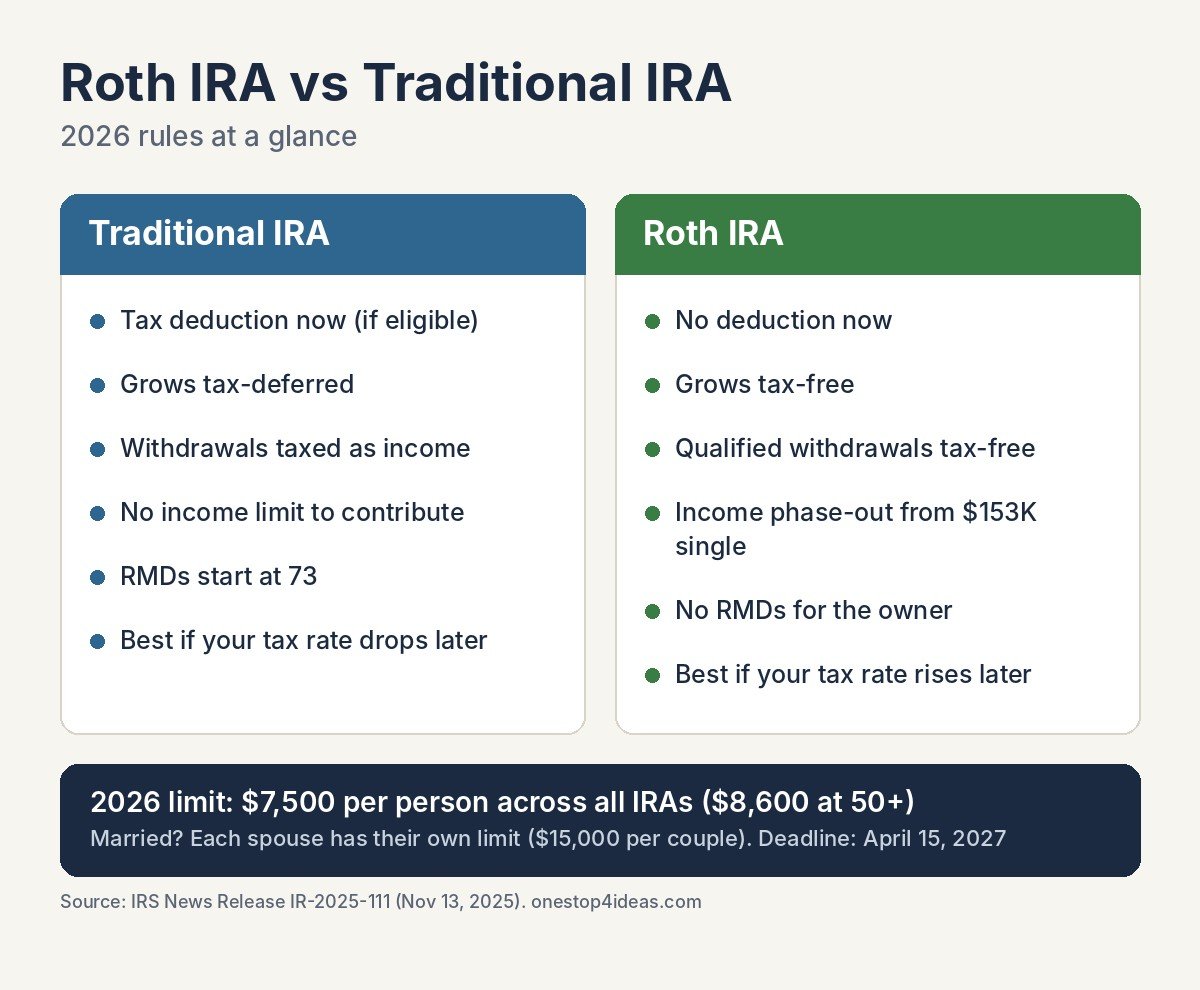
| Feature | Traditional IRA | Roth IRA |
|---|---|---|
| 2026 contribution limit | $7,500 ($8,600 at 50+), shared with your Roth | $7,500 ($8,600 at 50+), shared with your traditional |
| Income limit to contribute | None | Yes (phases out at $153,000 single / $242,000 joint MAGI) |
| Tax deduction now | Yes, if eligible | No |
| Growth | Tax-deferred | Tax-free |
| Withdrawals in retirement | Taxed as income | Tax-free if qualified |
| Early access | 10% penalty plus tax before 59½ (with exceptions) | Contributions anytime; earnings follow the qualified rules |
| Required minimum distributions | Yes, starting at 73 | None for the original owner |
| Best for | People who expect a lower tax rate in retirement | People who expect the same or a higher tax rate later, and younger savers |
A simple tax example
Say Maya, 35, is in the 22% federal tax bracket and invests $7,500 once, earning a hypothetical 7% a year for 30 years. It grows to about $57,092 in either account.
- Roth IRA: she gets no deduction today, but the full $57,092 is hers tax-free at 65.
- Traditional IRA: she saves about $1,650 in tax today (22% of $7,500). At 65, the $57,092 is taxable. If her tax rate in retirement is 12%, she keeps about $50,241. If it’s still 22%, she keeps about $44,532.
So the traditional IRA vs Roth IRA question really comes down to one thing: is your tax rate higher now or later? If you can’t tell, splitting your savings between both is a reasonable way to hedge.
Example figures are hypothetical, for illustration only, and don’t represent any specific investment.
Small habits, big totals
Consistency matters more than which account you pick. Contributing $7,500 at the start of every year for 30 years at a hypothetical 7% return adds up to roughly $758,000. Adding the $1,100 catch-up every year from 50 to 64 adds roughly $29,600 more by 65 under the same assumptions.
What is a backdoor Roth IRA?
A backdoor Roth IRA is a legal way for people above the Roth IRA income limits to get money into a Roth. It works because:
- Anyone with earned income can make a nondeductible traditional IRA contribution, at any income.
- Anyone can convert a traditional IRA to a Roth IRA. There’s no income limit on conversions.
Put those two together and you have a backdoor Roth. Fidelity’s guide to things to know about IRAs describes the same approach for people whose income is too high for direct Roth contributions.
Who should consider a backdoor Roth IRA?
- Your income is above the Roth limit (for 2026, $168,000 single or $252,000 married filing jointly), or you’re in the phase-out range and want to contribute the full amount.
- You have little or no money in pre-tax traditional, SEP or SIMPLE IRAs (see the pro-rata rule below).
- You can leave the money alone for at least 5 years.
How to do a backdoor Roth IRA, step by step
- Open a traditional IRA (if you don’t have one) and a Roth IRA at the same brokerage.
- Contribute up to $7,500 ($8,600 if 50+) to the traditional IRA as a nondeductible contribution.
- Wait for the money to settle, then convert the traditional IRA balance to your Roth IRA. Many people keep the cash in a money market fund until the conversion so there are few or no earnings to tax.
- File IRS Form 8606 with your tax return. It reports the nondeductible contribution (your “basis”) and the conversion, so you aren’t taxed twice on the same money.
- Repeat each year if your income is still too high.
Example: Ben and Carla (MAGI $260,000) each put $7,500 into a traditional IRA in January 2026 as nondeductible contributions and convert it to their Roth IRAs a week later. Neither has any other IRA money. Because their contributions were already taxed and there were no earnings, they owe $0 tax on the conversion, and $15,000 is now in their Roth IRAs.
The pro-rata rule: the biggest backdoor Roth trap
When you convert, the IRS doesn’t let you pick only the after-tax dollars. It looks at all your traditional, SEP and SIMPLE IRAs together, using their combined value at the end of the year of the conversion, and treats each conversion as a mix of pre-tax and after-tax money. This is the pro-rata rule.
Example: Sam has $92,500 in a rollover IRA from an old job (all pre-tax). He contributes $7,500 nondeductible and converts $7,500. His total IRA money is $100,000, and only 7.5% of it is after-tax. So only 7.5% of the conversion ($562.50) is tax-free, and $6,937.50 is taxable income.
How to avoid it: if your current employer’s 401(k) accepts incoming rollovers, you may be able to roll your pre-tax IRA money into the 401(k) before December 31 of the conversion year. 401(k) balances don’t count in the pro-rata calculation. Check your plan’s rules first.
Other backdoor Roth rules to know
- No undo button: conversions made in 2018 or later can’t be recharacterized (reversed) back to a traditional IRA.
- Each conversion has its own 5-year clock for the 10% penalty if you’re under 59½.
- Spouses are separate: the pro-rata rule applies to each person’s own IRAs, not the couple’s combined balance.
- Mega backdoor Roth is a different strategy. It uses after-tax contributions to a 401(k) that allows them, then moves that money to Roth. It depends entirely on your employer’s plan.
Spousal IRA: saving for a non-working spouse
If you’re married and file jointly, a spouse with little or no income can still contribute to their own traditional or Roth IRA, based on the working spouse’s income. Each spouse can put in up to the annual limit, as long as the total doesn’t exceed the couple’s taxable compensation.
Example: Nina earns $90,000 and her husband Omar stays home with their kids. For 2026, they can contribute $7,500 to Nina’s IRA and $7,500 to Omar’s, a total of $15,000, because their joint compensation is well above that.
Which IRA is right for you?
- Choose a Roth IRA if you’re early in your career, in a low tax bracket, expect to earn more later, or want flexible access to your contributions.
- Choose a traditional IRA if you’re in a high bracket now, qualify for the deduction and expect a lower rate in retirement.
- Use a backdoor Roth IRA if your income is above the Roth limits and you don’t have large pre-tax IRA balances.
- Do both if you’re unsure: tax diversification gives you more choices when you retire.
For more ways to lower your tax bill, read our guide to tax-efficient income and investment strategies. Once your IRA is open, you’ll also need to choose investments inside it; our semiconductor and chip stocks guide is one example of researching a sector before you buy.
FAQ
What is the IRA contribution limit for 2026?
The 2026 limit is $7,500 for traditional and Roth IRAs combined, plus a $1,100 catch-up if you’re 50 or older, for a total of $8,600. You can’t contribute more than your earned income for the year.
What are the Roth IRA income limits for 2026?
For 2026, single filers can make a full Roth contribution with MAGI under $153,000, a reduced one between $153,000 and $168,000, and none at $168,000 or more. For married couples filing jointly, the range is $242,000 to $252,000.
Can I have both a Roth IRA and a traditional IRA?
Yes. You can have both, but the $7,500 limit ($8,600 at 50+) is shared between them for the year.
How much can a married couple put into IRAs for 2026?
Up to $15,000 in total: $7,500 in each spouse’s own IRA, or $17,200 if both spouses are 50 or older ($8,600 each). If one spouse doesn’t work, you need to file jointly to use a spousal IRA, and your combined contributions can’t exceed your joint taxable compensation. For Roth IRAs, your joint MAGI also has to be under $242,000 for a full contribution (it phases out completely at $252,000), or you can each use a backdoor Roth IRA.
Is a backdoor Roth IRA legal?
Yes. It combines two allowed moves: a nondeductible traditional IRA contribution and a Roth conversion, which has no income limit. The key is to report it correctly on Form 8606 and watch out for the pro-rata rule.
What’s the deadline to contribute to an IRA for 2026?
You can contribute for 2026 until the tax filing deadline, April 15, 2027. A tax filing extension doesn’t extend the IRA contribution deadline.
Can I contribute to an IRA if I have a 401(k) at work?
Yes. Having a 401(k) doesn’t stop you from contributing to an IRA. It may only limit whether your traditional IRA contribution is tax-deductible, depending on your income. Roth IRA eligibility depends only on your income, not on your 401(k).
Can I withdraw money from my Roth IRA early?
You can withdraw your contributions at any time without tax or penalty. Earnings are tax- and penalty-free only after the 5-year rule is met and you’re 59½ or meet another exception.
Do Roth IRAs have required minimum distributions?
No. The original owner of a Roth IRA never has to take RMDs. Traditional IRA owners must start RMDs at 73 (75 for people born in 1960 or later).
What happens if I contribute too much to an IRA?
Excess contributions are taxed at 6% for each year they stay in the account. To avoid the tax, withdraw the excess (and any earnings on it) by your tax filing deadline, including extensions.
Is a Roth IRA or traditional IRA better for young people?
For most young savers, a Roth IRA is a strong choice: you’re often in a lower tax bracket now, you get decades of tax-free growth, and you can still reach your contributions in an emergency. Comparing a Roth IRA vs traditional IRA is mostly a bet on future tax rates, and younger people usually expect their income to rise.
Sources: IRS News Release IR-2025-111, IRS Publication 590-A and 590-B, IRS RMD FAQs, and Fidelity Viewpoints. Figures are for the 2026 tax year unless noted.



No Comment! Be the first one.